Peptides For High Performance Course
Finally Understand What Peptides Are, How They Influence Physiology, and How Clinicians Can Prescribe Them Responsibly In Personalized Protocols.

A science-backed foundational course —
for clinicians, Healthcare Professionals and high-performers who are done guessing and want to understand exactly how peptides work, how to use them responsibly, and why most protocols fail.
Save $500 — Enroll today for $1,497 $997
Discount automatically applied at checkout.
For Clinicians, Healthcare Professioanls, Biohackers & Organizations Seeking Expert Peptide Education

This is a foundational educational framework for understanding how clinicians think about peptide therapy — including physiology, safety considerations, and appropriate oversight.
Use Peptides with Clinical Precision Without Years of Trial-and-Error, Wasted Money, or Risky Experimentation
Develop a clearer understanding of why responses vary — and how clinicians think about sequencing, foundations, and safety before advanced interventions
Deepen your clinical and practical understanding through structured, expert-led programs designed for responsible application.

Reels, Shorts,
YouTube Videos

Social Media
Viral Posts

Sales Pages,
VSLs, & Webinars

Book & Content Writing

Full Course
Creation

Engaging on
Social Media
Here Is What's Inside This Course:
Build Your Foundation Before
You Experiment
The 5-Pillar Clinical Framework that replaces random peptide stacking with strategic sequencing, each approach is grounded in clinical reasoning, patient context, and safety-first decision making.
Stop Wasting Money on
Wrong Peptides
The Physiologic Sequencing System that helps reduce unnecessary trial-and-error by aligning peptide discussions with physiologic context and appropriate clinical oversight.
Monitor Responsibly
Over Time
The Clinical Monitoring Framework that helps clinicians evaluate response over time with clear markers for when to continue, adjust, or reassess. No more guessing.
...Learn How Clinicians Think About Peptides — Not Internet Protocols
Here Is What You'll Master
Inside This Course:
Module 1:
Body Composition & Metabolic Optimization
Understand how peptides are discussed in metabolic signaling, appetite regulation, and body composition — and why outcomes depend on foundations and clinical context. Master the foundation-first approach that separates lasting results from yo-yo rebounds.
Module 2:
Energy &
Mitochondrial Function
How cellular energy production actually works and why fatigue persists even when labs look normal. This is an often-overlooked layer in conversations around persistent fatigue and cellular energy.
Module 3:
Repair, Recovery
& Regeneration
Explore peptides that are being studied in tissue repair, collagen signaling, sleep, and regenerative pathways. Understand why healing is signal-dependent not automatic. Shift toward systems-level education and foundational physiology — not fragmented, trend-driven protocols.
Module 4:
Muscle, Strength
& Performance
Understand recovery signaling, structural integrity, and performance support across training and aging. Why restoration beats replacement.
Module 5:
Sexual Wellness
& Vitality
A responsible, whole-system approach to libido, vascular health, neurobiology, and connection. It's about presence, confidence, and connection.
PLUS: The Complete Clinical Framework
The 5-Pillar Physiologic Sequence — Key physiologic pillars clinicians commonly consider when evaluating peptide strategies.
Foundation-First Protocols — Why peptides fail without proper hormonal, metabolic, and lifestyle foundations in place
Clinical Monitoring Frameworks — Learn how clinicians evaluate response and tolerability
Safety & Exit Strategies — The difference between therapeutic response and red flag. General clinical considerations around reassessment, tapering, and long-term maintenance strategies
FDA Compliance & Sourcing Standards — Category 1 vs Category 2 distinctions, 503A pharmacy standards, and why "research use only" is not acceptable for human use.
...Learn How Clinicians Think About Peptides
— Not Internet Protocols
Course Tuition: $1,497
($3,947 Total Value)
For 48 hours after watching the masterclass:
Save $500 — Enroll today for $997
Discount automatically applied at checkout.
Here's Exactly What You'll Get Inside
The Peptides 101 Starter Guide: Build Your Foundation Before You Touch a Peptide
Why many individuals don’t get the outcomes they expect when foundational physiology and oversight are missing.
Your hormones are the foundation of the building. No matter how sophisticated the peptide protocol above, structural integrity depends on what's underneath. Skip this and you're building on sand.
The "Peptide Readiness" Checklist framework highlighting common clinical considerations clinicians may review when assessing appropriateness.
Most people start peptides when their cells can't even hear the signals. Learn the exact lab markers and physiologic prerequisites that separate responders from non-responders.
FDA Category 1 vs Category 2: The regulatory distinction most users don't understand
Understand key regulatory concepts and quality standards in an evolving landscape. This helps you better understand quality standards and sourcing risks to discuss with a licensed provider.

Stop experimenting on a broken foundation.
Understand what peptides actually ARE... signaling molecules that work WITH your biology, not against it... before you use them.
Module 1 on Body Composition & Metabolic Signaling: Master Metabolic Optimization
Why "weight loss peptides" fail when they should work... and the clinical sequencing that fixes it
You're not treating excess weight. You're treating dysregulated metabolic signaling. Learn why the same peptide produces dramatically different results in different people. And how to be in the group that responds.
A clinician-informed titration approach designed to improve tolerability and reduce common adverse effects
Dose escalated too fast = nausea, vomiting, medical crisis. Learn the exact titration protocols clinicians can use to support results while minimizing adverse events.
The "Exit Strategy" most peptide users never plan... and why long-term maintenance requires foundations beyond any single intervention
Most people gain everything back. Not because the peptide stopped working. Because they never built the metabolic foundation to sustain results. Learn the exit protocol that prevents rebound physiology.
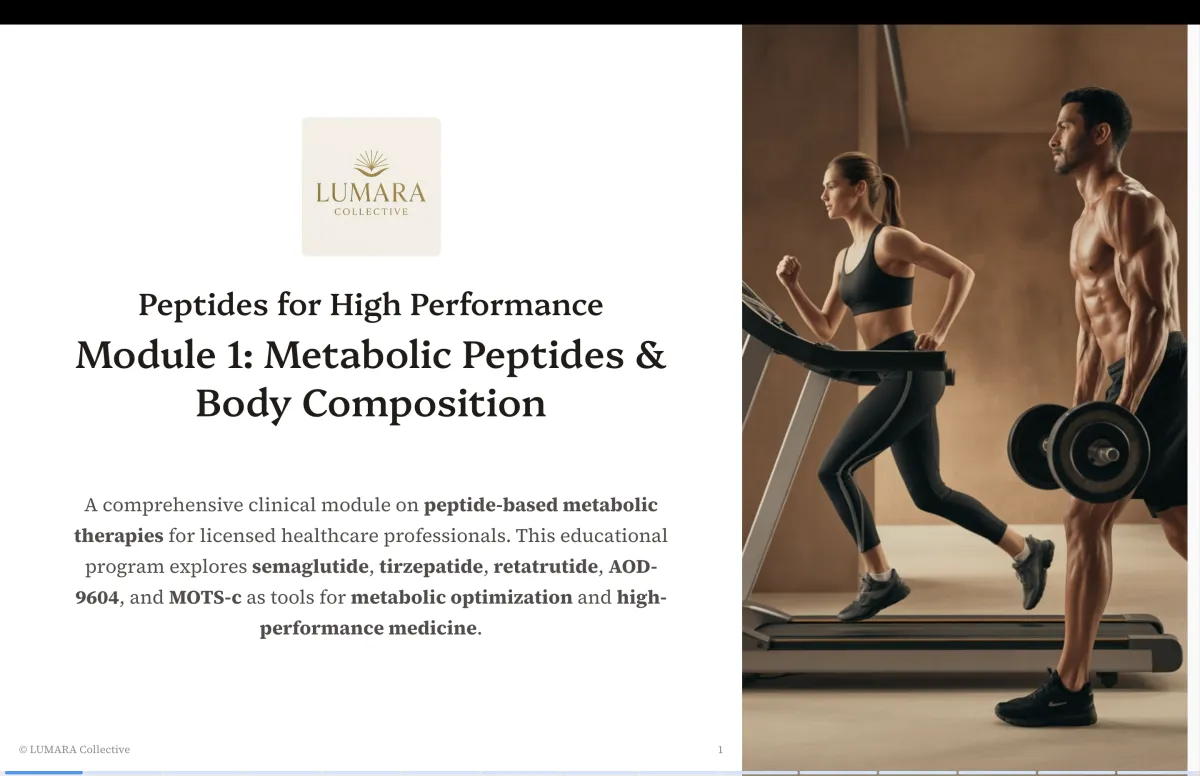
The one foundational requirement that makes or breaks every metabolic protocol
"'Optimization only works when the system is stable." If you're under-eating protein, sleep deprived, or inflamed... you're trying to out-signal a compromised cell. Learn what's actually non-negotiable.
This module reviews clinical context and consideration around:
Semaglutide, Tirzepatide, AOD-9604, MOTS-c. With dosing frameworks, safety monitoring, and intelligent pairings that prevent the failures plaguing most users.
Module 2 on Growth Hormone Optimization: Restore Your GH Axis Without Replacement
Optimization vs. Replacement: Why peptides work and exogenous GH eventually fails
Exogenous GH overrides your body's regulatory mechanisms. GH peptides may support endogenous signaling pathways in certain clinical contexts. Understand the difference. And why one builds long-term function while the other creates dependency.
The synergistic pairing principle that multiplies results (not just adds them)
GHRH + GHRP combinations aren't just additive. They're synergistic. Learn the specific pairings that create amplified responses from lower doses.
The cycling protocols that prevent receptor downregulation
Use the same peptide the same way indefinitely and your receptors go deaf. Learn the cycling frameworks that maintain sensitivity and long-term responsiveness.
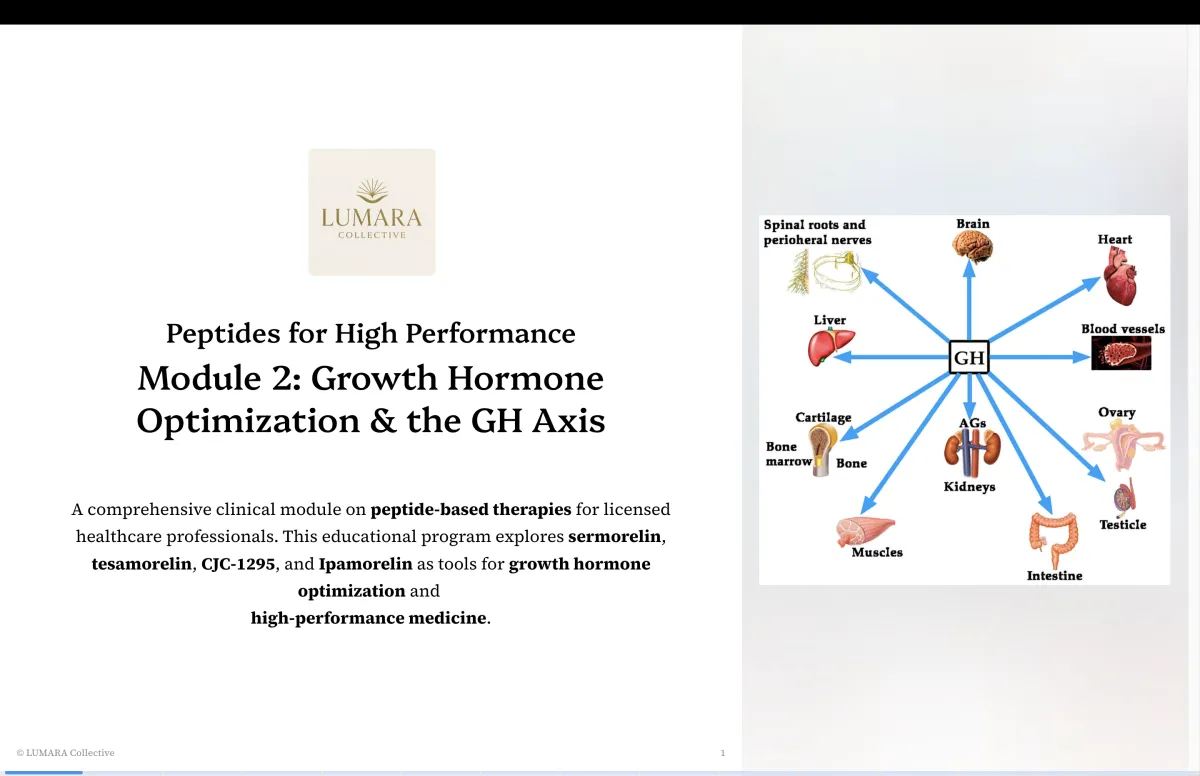
The 3 lifestyle factors that are NON-NEGOTIABLE for GH peptide success
Sleep, protein, resistance training. Without these, even perfect peptide protocols produce mediocre results. Learn exactly why. And exactly what "enough" means.
This module reviews clinical context and considerations around:
Sermorelin (gentle, foundational), CJC-1295 (enhanced signaling), Ipamorelin (clean GH amplification without cortisol/prolactin spikes), Tesamorelin (targeted visceral fat reduction).
Module 3 on Regenerative Signaling: Accelerate Repair & Recovery
Why GH peptides fail in injured tissue... and the "terrain optimizer" that fixes it
Growth hormone signaling fails in ischemic, inflamed tissue. BPC-157 is discussed in regenerative research contexts for its potential relationship to tissue recovery pathways. Learn why stacking order matters more than the stack itself.
BPC-157 and its emerging discussion in regenerative research and how it may be considered for multi-tissue repair
BPC-157 supports gut healing, tendon repair, and systemic tissue recovery. Learn the clinical applications, dosing considerations, and what it can (and can't) do.
Systemic remodeling: How TB-500 is discussed in research contexts for its relationship to repair signaling and recovery pathways
TB-500 doesn't just possibly reduce inflammation. It activates the cellular repair machinery. Understand the mechanism and when to use it vs. BPC-157.
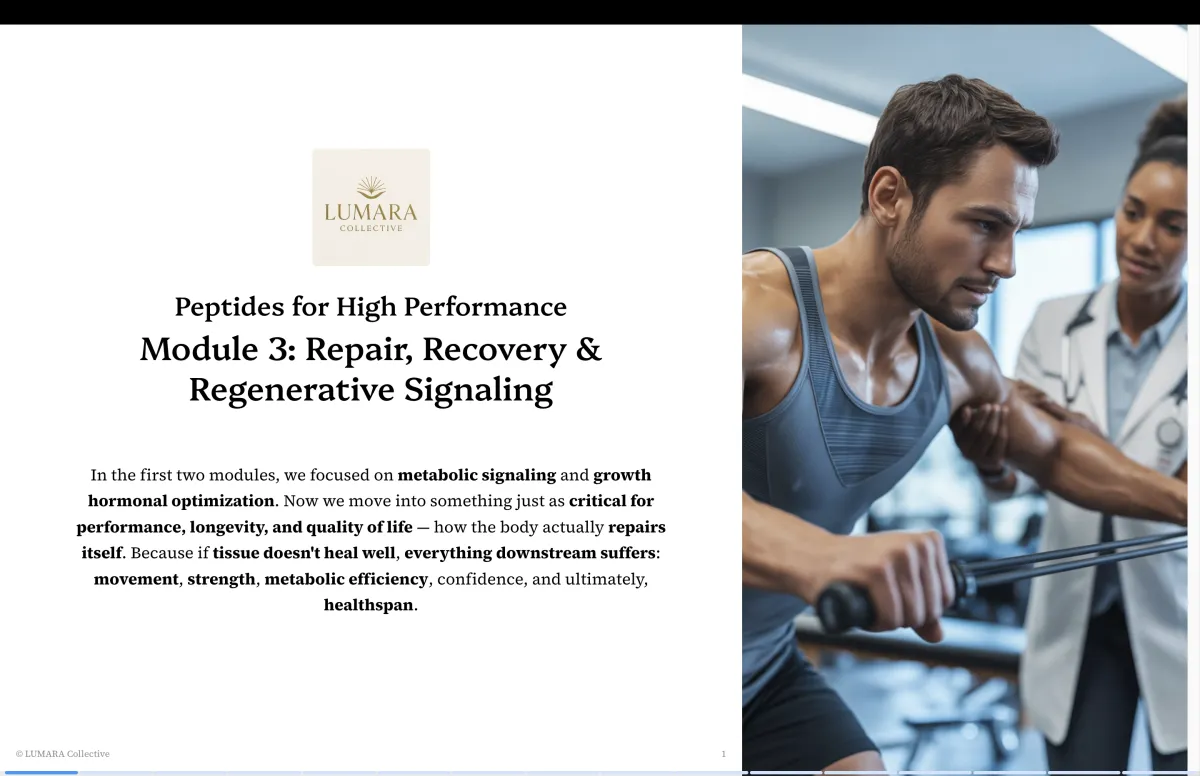
The underestimated collagen peptide most people overlook
GHK-Cu is studied for its relationship to collagen and connective tissue signaling. Learn why this matters for skin, connective tissue, and long-term structural integrity.
This module reviews clinical context and considerations around:
BPC-157, TB-500, GHK-Cu. With strategic stacking philosophy for comprehensive repair that addresses terrain, signaling, and structural remodeling together.
Module 4 on Mitochondrial Performance: Unlock Cellular Energy
The bioenergetic bottleneck that explains why "everything looks normal" but you're still exhausted
When mitochondrial function declines, everything downstream suffers. Even when hormones, nutrition, training, and labs appear normal. Learn to recognize the missing layer.
Structural restoration vs. metabolic acceleration: The critical distinction most get wrong
SS-31 doesn't stimulate mitochondria to produce MORE ATP. It restores structural integrity so existing mitochondria function efficiently. This is restoration, not acceleration.
The mitochondrial peptide encoded in mitochondrial DNA (and why that matters)
MOTS-c is a "retrograde signal" from mitochondria to nucleus. Unlike any other peptide. Understand why this unique origin creates unique therapeutic applications.
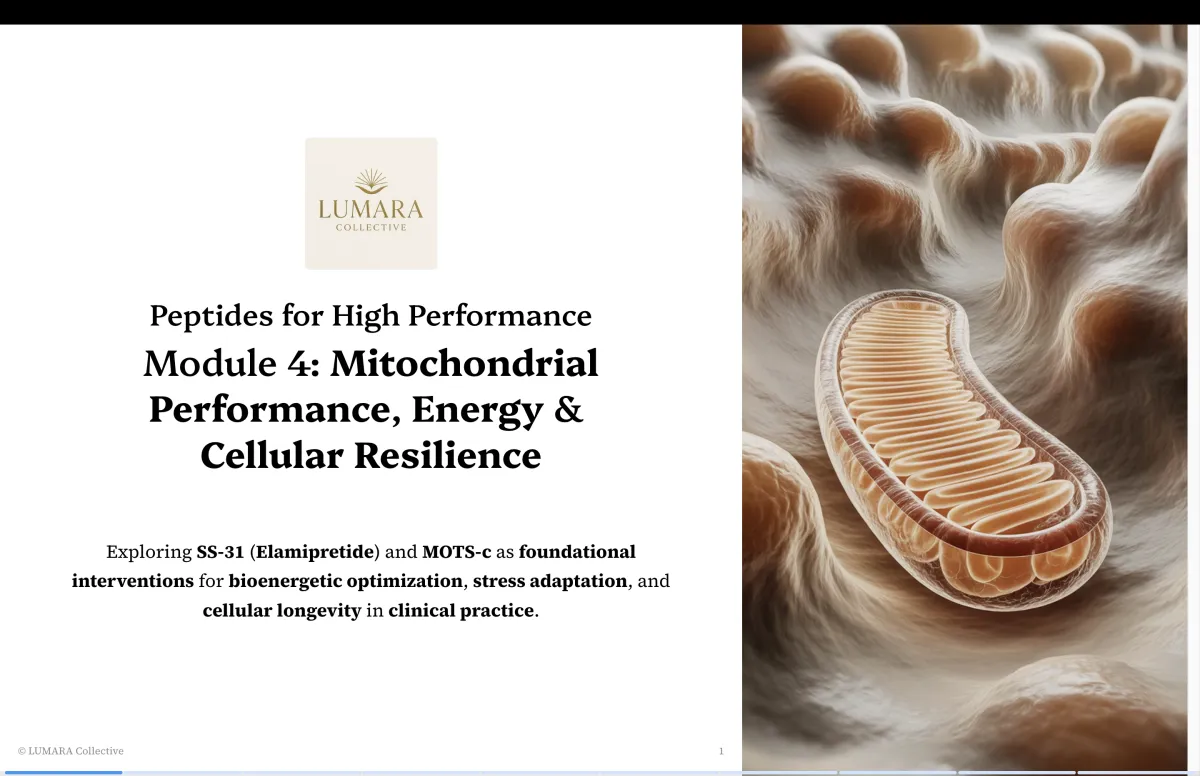
For the patient who's optimized everything and still feels depleted
When sleep, hormones, nutrition, and training are dialed and energy STILL limits performance... this is the intervention layer that addresses what nothing else can reach.
This module reviews clinical context and considerations around:
SS-31 (Elamipretide), a mitochondrial-targeting peptide studied in clinical research settings for mitochondrial and cardiometabolic dysfunction, and
MOTS-c. With clinical applications for energy, resilience, and cellular function.
Module 5 on Sexual Wellness: Restore Desire, Connection & Vitality
Why sexual health is "the canary in the coal mine" for underlying pathophysiology
Sexual biopsychosocial the intersection of every system. Biological, psychological, neurologic, relational. Dysfunction here is an early warning system, not a standalone problem.
Central desire vs. peripheral mechanics... and why PDE-5 inhibitors miss the point
PT-141 works centrally on melanocortin and dopamine pathways. Igniting desire and motivation independent of blood flow. Understand why this distinction changes everything.
The neurochemical substrate of authentic connection
Oxytocin doesn't artificially manufacture chemistry. It creates the neurobiologic CONDITIONS that allow authentic connection to emerge. Learn responsible clinical application.
The biopsychosocial framework for comprehensive sexual wellness
Central neurochemistry, endocrine regulation, vascular integrity, inflammatory status, emotional regulation, relational context. Address all layers or address none.
This module reviews clinical context and considerations around:
Bremelanotide (PT-141), FDA-approved for certain cases of acquired, generalized HSDD in premenopausal women, and Oxytocin. With a whole-system approach that addresses desire, connection, and presence... not just performance.
A 5-Pillar Clinical Education Framework to Support Responsible, Systems-Based Understanding of Peptide Therapy.
The Hidden Peptide Truth Nobody Talks About
There's A Sequence Your Body MUST Follow Before Any Peptide Protocol Works
Your cells aren’t ignoring you — they may simply not be receiving the message the same way anymore.
You’re eating right. Training hard. Sleeping enough. Labs look fine. But nothing is changing.
That’s because many interventions depend on healthy receptor sensitivity and intact signaling pathways — and those can downshift over time.
If you’re doing everything right and your body still won’t respond, it’s not a willpower issue.
It’s a communication issue at the cellular level.
Here's what most people never figure out:
Ever wonder why the same diet that helped you lose 20 pounds in your 30s does nothing now?
Your body hasn’t forgotten how to burn fat — but the underlying signaling environment has changed.
Every hormone you optimize. Every supplement you take. Every caloric deficit you create... and the response still feels muted.
That’s a cellular responsiveness problem — often rooted in receptor sensitivity, metabolic adaptation, and degraded signaling pathways over time.
And you can’t “out-discipline” a system that isn’t responding efficiently.
This is why your protocols keep falling flat.
Same tools as 10,000 other optimizers. Same “proven” stacks. Same research. Labs look fine. Energy is still low. Progress is still stalled.
You blame your genetics.
But the issue often isn’t your genes — it’s that the physiology you’re working with today is not the same physiology you had a decade ago.
No amount of optimization works when the signal isn’t landing.
Here's what people getting real results do differently:
They’re not chasing the latest peptide trend. They operate from a different framework entirely.
They understand something most peptide users never learn: You need to address the foundational terrain.
Skip a layer or optimize out of order, and you’re building on an unstable foundation.
Think of hormones and metabolic health as the groundwork of a building.
No matter how sophisticated the interventions above, structural integrity depends on what’s underneath.
That’s why random peptide stacking produces random results.
The peptide isn’t the problem.
The lack of education and personalization is.
Reels, Shorts,
YouTube Videos
Social Media
Viral Posts
Sales Pages,
VSLs, & Webinars
Book & Content Writing
Full Course
Creation
Engaging on
Social Media
So, What Can The LUMARA Performance Framework Do For You?
Support Cellular Response

Instead of forcing outcomes downstream, this framework focuses upstream — helping you understand the foundations that influence how the body responds to any advanced intervention.
Think in Pillars, Not Trends

Move beyond random stacking. Learn how clinicians evaluate metabolic terrain, recovery capacity, inflammation, mitochondrial function, and vitality markers when considering peptide strategies.
Think Like A Clinician

Filter every peptide decision through clinical reasoning, not influencer threads. Why does one protocol work at 0.5mg and another fail at the same dose in a different person? This framework gives you the "why" behind every "what."
Avoid The Costly Mistakes

Know the difference between therapeutic response and red flag. Understand which peptides require which foundations. Stop experimenting blind and start optimizing with precision. Reduce unnecessary trial-and-error and improve safety through better clinical reasoning and foundational support.
Learn to Read the Terrain

Identify which systems may need attention before selecting an intervention. Outcomes depend on context: cellular health, receptor sensitivity, stress load, sleep, and system stability.
Build A Lasting Foundation

Stop the cycle of protocol hopping, watching it work, then watching it fail. Every "winner" protocol eventually stops working when the foundation beneath it degrades. This framework is designed to support long-term, individualized strategies grounded in physiology — not short-term trend cycling.
Why This Training Stands Apart
When this framework is applied thoughtfully,
three core shifts occur:
Physiologic Context Before Intervention
You learn to think in systems — understanding the core physiologic pillars clinicians consider when evaluating peptide strategies: metabolic terrain, recovery pathways, inflammation and repair, mitochondrial function, and vitality markers. Instead of random stacking, you develop a grounded framework for individualized decision-making.
Education Before Experimentation
No more guessing your way through fragmented advice. No more “trust me bro” protocols from internet threads. You develop clinical reasoning that explains the “why” behind every “what” — so you can engage with peptide therapy responsibly, with clarity rather than hype.
Safety Before Optimization
You learn how clinicians assess foundations that may influence response — including hormonal balance, metabolic stability, inflammation, and overall terrain. You understand common safety considerations, how to recognize red flags, and why peptide therapies should only be pursued under licensed medical supervision.
The LUMARA Performance Framework isn't about chasing trends. It’s about building a responsible, systems-based foundation for long-term clinical reasoning and informed decision-making.
You'll gain:
A clear mental model of how peptides work with your body's existing pathways
Greater clarity on what peptides may do — and their limitations
The ability to ask better questions of any clinician or protocol
A standard you can trust—regardless of where you are in your peptide journey
This is precision-minded education applied to regenerative biology: understanding how signaling molecules interact with physiology — and how clinicians think about supporting intrinsic processes rather than overriding them.
The "Peptides for High Performance" Course
Is Perfect For You If:
You're a clinician who wants to add peptide therapy to your practice but don't know where to start
You've seen the research. You know peptides are the future of longevity medicine. But every time you try to figure out protocols, dosing, and sourcing, you hit a wall of conflicting information.
You're a high-performer or biohacker who's done "everything right “and your body still feels stalled
You're not looking for another supplement stack. You want to understand why physiologic responsiveness can shift over time — and how clinicians think about supporting the underlying terrain.
You've tried peptides before but didn't get the results you expected
Maybe you ran BPC-157 for an injury. Or experimented with a GH secretagogue. It "kind of" worked... but not like you hoped. Now you're wondering if you picked the wrong peptide, wrong dose, or wrong sequence entirely.
You're overwhelmed by conflicting information and "trust me bro" advice online
Reddit threads. Random influencers pushing protocols with zero clinical training. Everyone's an expert but no one can explain the "why". You need a framework, not more noise.
You're too informed to ignore peptides but too responsible to wing it
You know peptides work. But you also know the cost of getting this wrong isn't just wasted money. It's avoidable side effects, poor outcomes, avoidable risk and unnecessary trial-and-error.
You're ready to stop protocol hopping and finally build a foundation that lasts
You're done watching protocols work then fail. Done chasing the latest peptide trend. You want a clinical framework for understanding the key pillars that influence peptide response and safety.

This Course Is NOT For You If:
You're looking for a shortcut to self-treat without any medical oversight or licensed provider involved.
You want a list of doses to copy — not an understanding of why those doses might apply (or not) to you.
You're not willing to work with a licensed clinician for actual peptide therapy decisions.
You want to skip the physiology and go straight to a protocol without understanding why it works.
You expect this to be personalized medical advice rather than foundational, educational training.
Here’s Proof Straight From Our LUMARA Community
★★★★★
This is the first peptide course I’ve taken that truly teaches physiology — not just peptide names and dosing. That distinction makes a huge difference.
— NP, Functional Medicine
★★★★★
This course teaches far more than peptide names — it shows you when to consider using them and the clinical thought process behind evaluating each patient. That’s what was missing from many of the programs I researched. Ashley delivers exactly what ethical peptide medicine requires.
— Physician, Women’s Health & Menopause
★★★★★
I literally told my husband, ‘This is why I love learning.’ The way Ashley teaches peptides is an art — and patients deserve that level of care.
— NP, Anti-Aging & Aesthetics
★★★★★
This course was outstanding. I highly recommend it to anyone looking for peptide education with real substance and clinical depth.
— PA, Orthopedic Surgery
TESTIMONIAL DISCLAIMER:
All testimonials provided are individual experiences only. Results and experience are not typical.
Meet Your Instructor
Ashley Madsen, PA-C, HHC, ABAAHP

Clinician | Global Speaker & Educator | Advancing Longevity Science, Hormones, Metabolic Health, Peptides, Sexual Wellness & Genomics
Ashley Madsen, PA-C, HHC, ABAAHP is a board-certified clinician and global educator specializing in longevity science, metabolic health, hormone optimization, and peptide therapy.
As Co-Founder and Chief Clinical Architect of LUMARA Collective, she designs evidence-based health optimization frameworks for high performance individuals, elite medical clinics, and advanced wellness organizations worldwide.
She has trained and advised elite athletes, C-suite executives, entrepreneurs, and top-tier medical clinics globally, translating complex science into practical, responsible frameworks that deliver measurable outcomes — without hype or unsafe shortcuts.
With over a decade of experience in surgical medicine and advanced clinical training from Stanford University, IFM, and A4M, Ashley is known for bringing clarity, rigor, and systems-level thinking to one of the fastest-evolving areas of modern medicine.
Learn directly from a clinician who teaches peptides with rigor, responsibility, and systems-level thinking.
🎓 Stanford University — Advanced Clinical Training
🎓 Institute for Functional Medicine (IFM)
🎓 American Academy of Anti-Aging Medicine (A4M)
Frequently Asked Questions…
Who is this course for?
Three types of people. First, clinicians who want to prescribe peptides with confidence and clinical reasoning, not just follow protocols blindly. Second, high-performers and biohackers who are done guessing and want to understand the clinical reasoning behind different approaches. Third, anyone who's tried optimization strategies that should have worked but didn't.
Do I need a medical background?
No. The course is designed so you think like a clinician without needing to be one. You'll understand the "why" behind every protocol. That means smarter conversations with your providers and better decisions for your own body.
I've tried peptides before and didn't get results. Will this help?
Probably. Many disappointing peptide experiences stem from missing context — foundations, timing, expectations, route, or lack of proper clinical oversight. This course explores this in greater detail.
What makes this different from free information online?
Structure, sequence, science and safety. Online information is fragmented, contradictory, and often dangerous. This course gives you a clinical understanding. Not a random menu of peptides to experiment with.
Is this about how to self-administer peptides?
No. This is education, not medical advice. Peptide therapy should only happen under licensed medical supervision. The course gives you the knowledge to make more informed decisions. Not to bypass proper care.
What about FDA regulations? Are peptides legal?
This is one of the most misunderstood areas. The course covers Category 1 vs Category 2 distinctions, why route of administration matters, and why "research use only" products are not appropriate in the majority of settings. Regulations are evolving and therefore staying up to date on your specific governing boards and limitations, as well as understanding the landscape is essential.
Does the course tell me where to get peptides?
It teaches you what pharmaceutical-grade means. 503A compounding pharmacies with identity verification, purity testing, sterility, and USP compliance or FDA approved manufacturers are discussed. You'll understand the standard you should never compromise on.
Can I just learn about one specific peptide I'm interested in?
You can. But you'll miss the point. Random experimentation produces random results. Even if you came for BPC-157 or semaglutide specifically, you'll learn why it works or fails based on your foundation.
Is this just theory, or will I get practical protocols?
Both. You'll understand the physiological "why" plus clinical frameworks for dosing, titration, cycling, monitoring, and exit strategies. Not memorizing protocols. Developing reasoning. Of course this is for educational purposes only, NOT medical advice and you should always work with a licensed medical clinician and within the scope of your medical boards.
What about side effects and safety?
Safety is embedded throughout. You'll learn common known side effects, contraindications, clinical failures, what separates therapeutic response from red flags, and why "more peptide" rarely means better results.
What if I'm a clinician who already knows about peptides?
You'll go deeper. Clinical reasoning for sequencing, peptide selection, combination protocols, monitoring markers, strategies, and the framework that separates confident medical practitioners from protocol-followers.
Ready to Build Your Foundation?
Stop guessing and start learning the clinical framework behind safe, effective peptide use. Enroll in Peptides for High Performance today.
Disclaimer
This program is for educational purposes only and does not provide medical advice, establish a provider–patient relationship, or replace individualized clinical care. Clinical decisions must be made by licensed professionals in accordance with applicable laws and standards of care.